

OEM and ODM Furniture Projects: A Seven-Stage Process from Drawing to Container
What this guide covers
- OEM versus ODM — choosing the right model
- Stage 1: Requirement brief and feasibility
- Stage 2: Design development and drawings
- Stage 3: Material and finish approval
- Stage 4: Sampling and the approved sample
- Stage 5: Production and in-process control
- Stage 6: Final inspection and packing
- Stage 7: Shipping and handover
- The change-control rule that prevents most disputes
- Conclusion
OEM versus ODM — choosing the right model
The two terms are frequently used interchangeably, but they describe different starting points and carry different risks.
| OEM | ODM | |
|---|---|---|
| Starting point | Buyer supplies the design | Manufacturer offers an existing design |
| What the manufacturer provides | Manufacturing to specification | Design, development and manufacturing |
| Tooling & drawings | Usually buyer-owned | Usually manufacturer-owned |
| Speed to first sample | Slower — design must be interpreted | Faster — a base design already exists |
| Differentiation | High; product is the buyer's | Lower unless customisation is layered on |
| Main risk | Misinterpretation of the buyer's drawing | Product available to other buyers |
In practice most furniture projects sit between the two. A brand may start from a manufacturer's console table design — the ODM route — then specify its own dimensions, timber species, colour and hardware, which reintroduces OEM characteristics. What matters is being explicit about which model applies, because it determines who owns the drawings, who carries design risk, and how much of the schedule is spent on development rather than production.
Stage 1: Requirement brief and feasibility
The brief is where most of the project's cost is decided, and it is usually the stage given the least attention. A brief that specifies only a product category and a target price leaves the manufacturer to make assumptions that will later need to be unwound.
A workable brief covers:
- Product and intended use — residential, hospitality, retail display, or contract furniture for commercial installation. Intended use drives the required durability standard more than any other input.
- Dimensions and critical fits — overall, and specifically which dimensions are functional rather than nominal. A drawer must fit; a decorative reveal has more tolerance.
- Volume — first order quantity and expected annual run. This shapes tooling decisions and material ordering.
- Target price and the priority — where the buyer wants cost removed if the target is not met: simpler joinery, thinner panels, or reduced finish coats.
- Destination market and compliance — which determines finish limits, labelling and packaging requirements.
- Timeline — including the date the goods must leave the factory, not only the date they must arrive.
Feasibility review follows directly. The honest output of this stage is sometimes that the brief cannot be met at the target price without changing something material — and establishing that in week one is far cheaper than establishing it after sampling.

Stage 2: Design development and drawings
Once the brief is settled, the design is developed into drawings precise enough to be manufactured from. For an OEM project this means interpreting the buyer's design; for an ODM project it means adapting an existing product to the specified changes.
Two outputs matter at this stage:
- A dimensioned drawing set covering every component: overall dimensions, panel thicknesses, joint locations, hardware positions and clearances.
- A finish schedule naming the species, coating system, sheen level and colour reference for each visible surface — including the surfaces nobody photographs, such as the inside of a drawer and the back of a cabinet.
It is also worth agreeing the tolerance convention. A drawing with dimensions but no stated tolerances invites two reasonable readings, and the difference between them becomes a dispute during inspection. Stating where tolerances are tight — mating faces and functional clearances — and where they are loose, such as decorative edges, avoids unnecessary cost and unnecessary argument.
Stage 3: Material and finish approval
Timber is a natural material, and no two boards are identical. Colour and grain therefore need approving as a range, not as a single perfect example.
A practical approval pack contains:
- Physical timber swatches in the specified species, showing the range of grain and colour that will be accepted rather than one pristine sample.
- Finish panels in the specified system and sheen, applied to the specified species, so the buyer sees the real interaction of coating and timber.
- Hardware samples, or at minimum a specification with an approved equivalent clause.
- Assembly sections showing the joint types that will be used at structural connections.
Approving a physical sample is materially safer than approving from photographs. Screen calibration, ambient light and camera processing all shift colour, and a photograph approved on a phone has caused a great deal of avoidable rework. Where the buyer cannot attend in person, a physical sample shipped to them remains the standard that both sides can return to.
Stage 4: Sampling and the approved sample
The sample is the contract's technical baseline. Everything produced later is compared against it, so the value of the sample depends entirely on how precisely it is captured.
Two habits make a sample useful rather than decorative:
- Seal or photograph it in detail. Keep the approved sample physically intact where possible, and photograph it under consistent lighting with close-ups of joinery, finish and hardware.
- Record the deviations. If the sample differs from the drawing — and it often will, in a way that is acceptable — write down what changed and confirm it. Silent deviations become problems when production scales up, because the sample quietly becomes the de-facto specification.
Sample lead time is the place where projects most often lose their schedule, because it sits on the critical path but is frequently treated as a formality. It is worth asking early how many sample rounds are typically required and what the realistic turnaround is, rather than assuming a single round.
Stage 5: Production and in-process control
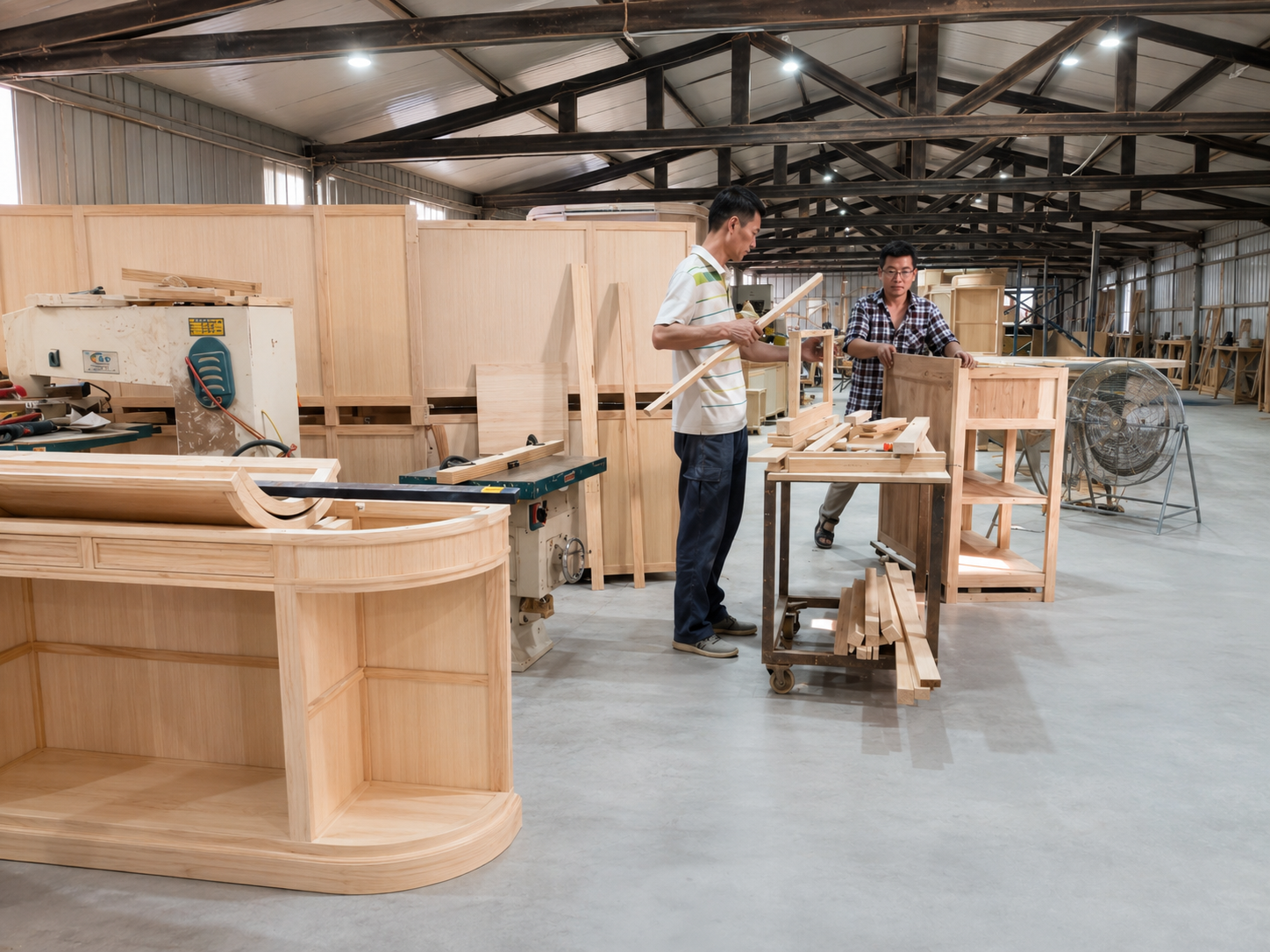
Once the sample is approved, production begins — and the quality question shifts from capability to consistency. A factory that can produce one excellent cabinet is not the same as one that can produce two hundred identical ones.
Consistency depends on process control at a handful of checkpoints:
- Incoming material inspection — species, moisture content and grade checked before machining rather than after.
- Machining accuracy — component dimensions verified against the drawing, because errors here propagate into assembly and cannot be corrected later.
- Assembly checks — joint tightness, squareness and racking resistance, checked on the first units of the run rather than only at the end.
- Finishing control — film build, sheen and colour compared against the approved panel, particularly at the start of each shift.
The first-off inspection deserves particular emphasis. Checking the first unit of a production run against the sample, and confirming it before the run continues, catches setup errors while the cost of correction is still low.
Stage 6: Final inspection and packing
Final inspection is the buyer's last opportunity to catch a problem before it becomes an international freight claim. A defined checklist, applied to a sample of units rather than one hand-picked example, is the difference between inspection and reassurance.
| Checked | What is being verified |
|---|---|
| Structure | Joint integrity, squareness, freedom from racking; doors and drawers operate correctly |
| Dimensions | Overall and functional dimensions against the approved drawing |
| Surface finish | Colour, sheen and film quality against the approved panel; no runs, dust or sanding marks |
| Hardware | Correct fitment, alignment and operation of runners, hinges and handles |
| Stability | Level standing and appropriate load-bearing behaviour for the intended use |
| Packing | Edge protection, corner protection, moisture barrier and carton strength |
Packing is a quality feature, not a logistics afterthought. Solid wood furniture is heavy, and much of the damage that occurs between factory and destination comes from movement inside the carton rather than from impacts on the outside. Corner protection, internal blocking that prevents shifting, and a moisture barrier for sea freight are all worth confirming explicitly — particularly for long ocean transits that cross significant humidity gradients.
Stage 7: Shipping and handover
The final stage is where commercial terms and physical reality meet. The Incoterm chosen — EXW, FOB, CIF, DDU or DDP — determines who arranges freight, who carries risk at each point, and who handles import formalities. Buyers new to importing often underestimate the work embedded in the later terms; DDP in particular places customs clearance and duties on the supplier, which is convenient but should be priced accordingly.
The documents that accompany the shipment matter just as much as the packing. Commercial invoice, packing list and the relevant certificate of origin need to be consistent with each other and with what is physically in the container. Discrepancies at this stage do not damage the furniture, but they reliably delay it.
The change-control rule that prevents most disputes
Almost every serious dispute in a custom furniture project traces back to a change that was agreed informally and priced or scheduled differently by the two sides.
A single rule prevents the great majority of them: any change to the drawing, specification or schedule must be recorded in writing, dated, and reflected in a revised price and delivery date before it is implemented.
Conclusion
A custom furniture project is a sequence of approvals, and its outcome is largely determined by how deliberately those approvals are handled. The brief sets the cost, the drawing sets the product, the sample sets the standard, and change control keeps all three aligned as the project runs.
For buyers, the most useful preparation is to decide in advance who will approve drawings, who will approve the sample, and in what form approval will be recorded. Projects that answer those three questions before sampling begins rarely discover their problems at the container.
Start a custom furniture project
Hengshui Yuyufeicheng Furniture Co., Ltd. is a solid wood furniture manufacturer integrating design, production, customisation and sales. Our facility combines standardised workshops, a painting room, a smart warehouse and a showroom, and we produce for homes, hotels, homestays, tea rooms and commercial spaces. OEM and ODM enquiries are welcome.
Send your drawingsLead times, tooling arrangements and Incoterms are project-specific. Confirm them in writing before production begins.